If you searched "auto transport no broker" or "car shipping direct carrier" before you found this page, I know exactly what you were looking for.
You were not looking for a truck driver specifically. You were looking for someone who picks up the phone, tells you the truth, shows up when they say they will, and does not take your money and disappear.
You were looking for accountability.
I am going to tell you something that might surprise you: so am I. And I am a broker.
The problem you were trying to solve by cutting out the middleman is real. The solution of going directly to a carrier is not — and I can tell you exactly why, because I spent years inside this industry watching what happens when customers try it.
What a Broker Actually Does — For Both Sides
Before I explain why going direct creates more problems than it solves, let me tell you what a broker is actually supposed to do. Because most of what you have heard about brokers describes bad brokers — not the role itself.
A driver running an auto transport truck typically has seven or eight spaces to fill on a single load. That driver does not have time to sort through a hundred quote requests a day looking for the six or seven customers who are on his route, ready to go in his schedule, and serious about booking. That is not his business. His business is driving.
My job is to find customers like you — solidify your pickup window, confirm your vehicle details, verify your timeline — and then match you with a driver who can fill your slot on a route he is already running. That driver earns enough to make the route worth driving. You get a carrier who is committed to your move because your vehicle is part of a full load that makes economic sense for him.
When that match works correctly, both sides win. The driver runs a full truck. You get a pickup that actually happens.
That is what brokerage is supposed to look like. What it looks like when it does not work is a different conversation — and it is the reason you were searching for alternatives in the first place.
Here is something the industry does not advertise: many of the companies showing up in searches for "direct carrier auto transport" are brokerages.
They claim to own trucks. They hope you do not check their DOT number. If you did — in sixty seconds at safer.fmcsa.dot.gov — their paperwork would show a broker company, not a carrier. No trucks. No drivers on staff. A brokerage that decided the word "broker" was costing them business.
I know this because I secret shopped one of them.
I spoke with someone on their sales team. He told me they had a driver right around the corner that was ready to pick up. He originally offered to pick me up same day and then said he could do the next day. I told him it was unbelievable that he had a driver who happened to be around the corner from my pickup location. He assured me that it was due to their high level of service and he could have the driver call me to confirm.
Five minutes later, a call came in from a similar number — same area code. I looked it up. It came back to that same brokerage. The person on the line claimed to be a truck driver and claimed that they were around the corner. I asked him some questions about the location. They were not able to answer any of them because they were not there. When I asked him if he worked for the brokerage, he stuttered and hung up on me.
A customer who does not know how this industry works would never catch that. They would think they booked directly with a driver. They would have no idea they were talking to someone running a script from a desk. The driver who eventually showed up — if one did — would be someone they knew nothing about, dispatched by a company that misrepresented itself to get the booking.
The DOT number search takes sixty seconds. Search any company at safer.fmcsa.dot.gov before you book. If their authority type shows Broker rather than Carrier — you are talking to a broker regardless of what they told you on the phone.
Here is what actually happens when you book directly with a carrier who does not have enough freight to fill their truck on your route.
They do not come pick up your vehicle. Or they come get it and you wait — sometimes days — while they reach out to fill the rest of their available space. You were the first booking on a load that was not ready to move yet. Your vehicle sits while the carrier builds the rest of their load around you.
A truck is not going to travel three thousand miles with one car on it. That is not economically viable for the driver. So either the pickup slips while they find more freight, or they start calling brokerages to fill their remaining spaces — which is exactly what you were trying to avoid.
This is the specific problem a broker solves. I already know what is moving on a given route in a given week. I am not building a load from scratch around your vehicle — I am placing your vehicle into a load that is already forming. That is why the 72-hour pickup window works. The load exists. I am finding your slot in it.
When you book directly with a carrier — even a legitimate one — you are booking without the legal framework a broker provides.
On every order I dispatch, the customer has a signed rate confirmation showing exactly what the move costs. The carrier has a signed carrier agreement showing exactly what they are owed. The Bill of Lading documents the vehicle's condition at pickup with signatures from both parties. Everyone knows the price. Everyone knows the terms. Everything is in writing.
Here is what that means at delivery.
A driver shows up and says the price is now higher than what you agreed. There was a suitcase in the back seat. He had to jump start the car. Whatever reason he gives for the number he now wants.
With a broker and a contract, you hand him the rate confirmation. It says what it says. That is what the carrier agreement he signed says he is owed.
If he refuses to release the vehicle — and I say this as someone who spent ten years in law enforcement — you call the police.
I tell every customer this directly: if a driver will not release your vehicle at delivery, call the local police department. This is a civil matter. The police are required to have that vehicle released to the rightful owner. The driver can pursue the disputed amount through small claims court if he chooses. He will not — because the extra charge was not legitimate and he knows it.
Without a broker and without a contract, you have no piece of paper. No rate confirmation. No carrier agreement. No terms anyone signed. Your car is on his truck and you have no documented agreement to stand on.
I avoid this situation entirely by running full credit card processing on the customer side and paying the carrier directly after delivery. The driver knows he gets paid when the vehicle is delivered clean and the Bill of Lading is signed. That is his incentive to deliver professionally. That incentive disappears when there is no broker holding payment and no contract establishing what anyone agreed to.
Worth noting: even the one carrier from that test with valid, matching coverage wouldn't sign a rate confirmation or carrier agreement. Insurance and a willingness to work inside a documented, accountable process are two different things — you need both, and finding one doesn't guarantee the other.
Some carriers run without adequate insurance. Some run without proper operating authority. When you find a carrier and book directly, you are responsible for verifying their authority and insurance yourself.
Most people do not know how to do that. Even people who try often do not know what they are looking at when they pull up a carrier's federal profile. Is the cargo insurance current? Is the coverage amount adequate? Is the authority active or was it reinstated after a lapse? These are not obvious questions for someone who does not work in this industry.
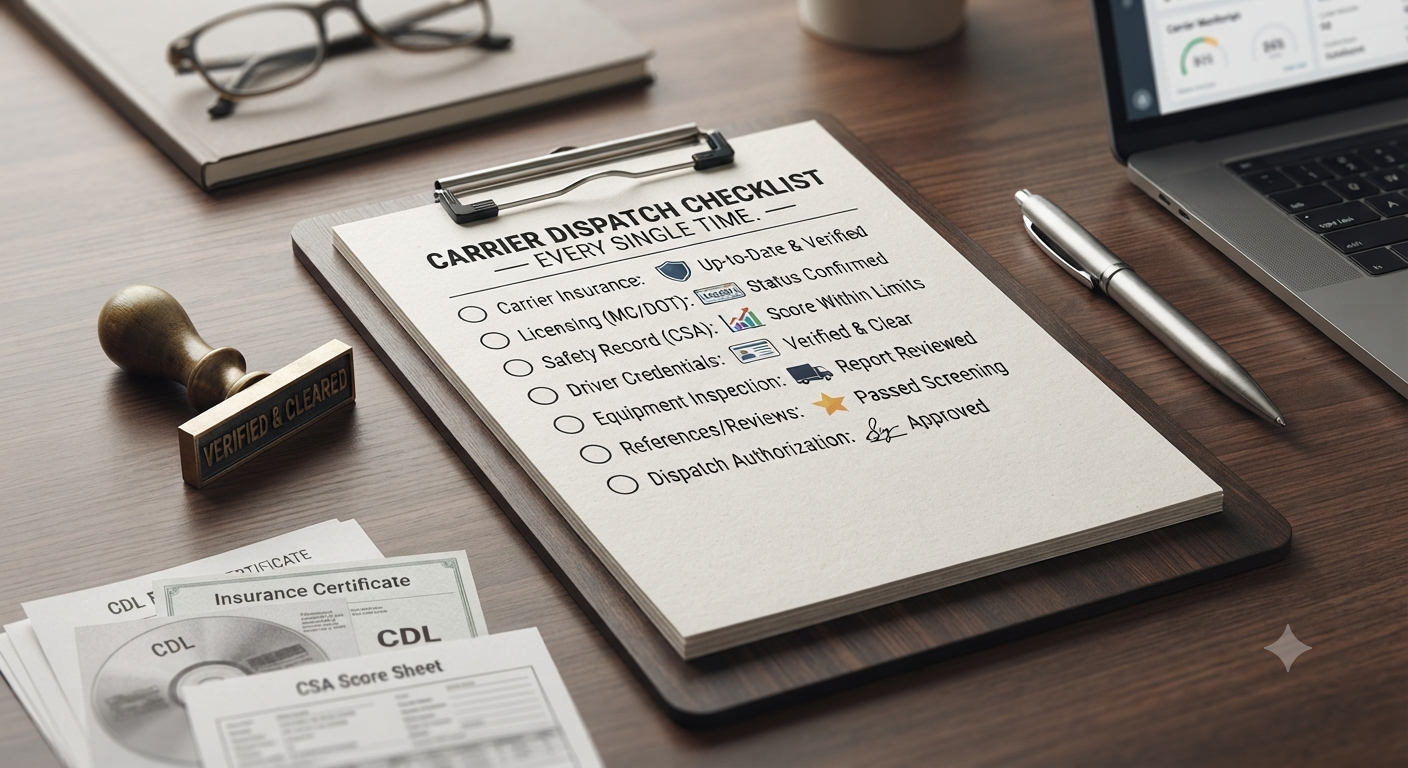
A broker who does their job correctly verifies all of this before dispatch — not as a courtesy but as a professional obligation. When I dispatch a carrier I have confirmed their authority is active, their insurance is current and adequate, and their safety record does not disqualify them from moving your vehicle.
When you book direct, you are the verification layer. If you do not know what you are looking at, that layer does not exist.
I tested this myself recently. I had a route I was struggling to fill, so I posted it in one of the Facebook groups built around exactly this pitch — skip the broker, deal with the carrier directly. About 20 people reached out with offers. The moment I said I was a broker and asked for a certificate of insurance, several went quiet and never responded again. That doesn't prove they weren't insured. It's not nothing, either. Of the rest, only three ever actually sent a policy, and I stayed anonymous about being a broker until after I'd read what they sent.
Two of the three were running a scheduled-auto policy that didn't list the truck they were actually planning to use — coverage that looks completely real and current, and simply doesn't apply to that vehicle. The third had an any-auto policy and was a carrier I'd worked with before, so that one I could actually use.
Having a policy and having a policy that covers what's happening on the road are two different things, and most people asking "are you insured" never get past the first one. The carriers willing to hand one over at all are often counting on that. Some of what I saw lines up with a pattern the industry already has a name for — "chameleon carriers" — trucks and coverage getting shuffled between different entities so no single one of them is left holding the liability when something goes wrong. I can't prove that's what happened with the ones who went silent. I don't think it's a coincidence either.
For a full breakdown of what responsible carrier verification looks like — read: What We Check Before Your Carrier Is Dispatched — Every Single Time.
What You Were Actually Looking For
Here is the thing. When I talk to customers who searched "no broker" before they called me, we usually end up in the same place pretty quickly.
They did not actually want to manage a carrier relationship. They did not want to verify insurance themselves. They did not want to chase down a driver who stopped responding. They wanted someone who would handle all of that and be straight with them about what it cost.
That is a broker.
I started this company because I believed that transparency, accountability, and picking up the phone were not a premium service — they were the baseline. Show you the numbers. Vet the carrier before your vehicle moves. Be honest about what is possible and what is not.
If that is what you were looking for when you searched for a direct carrier — you found it. Just not in the way you expected.