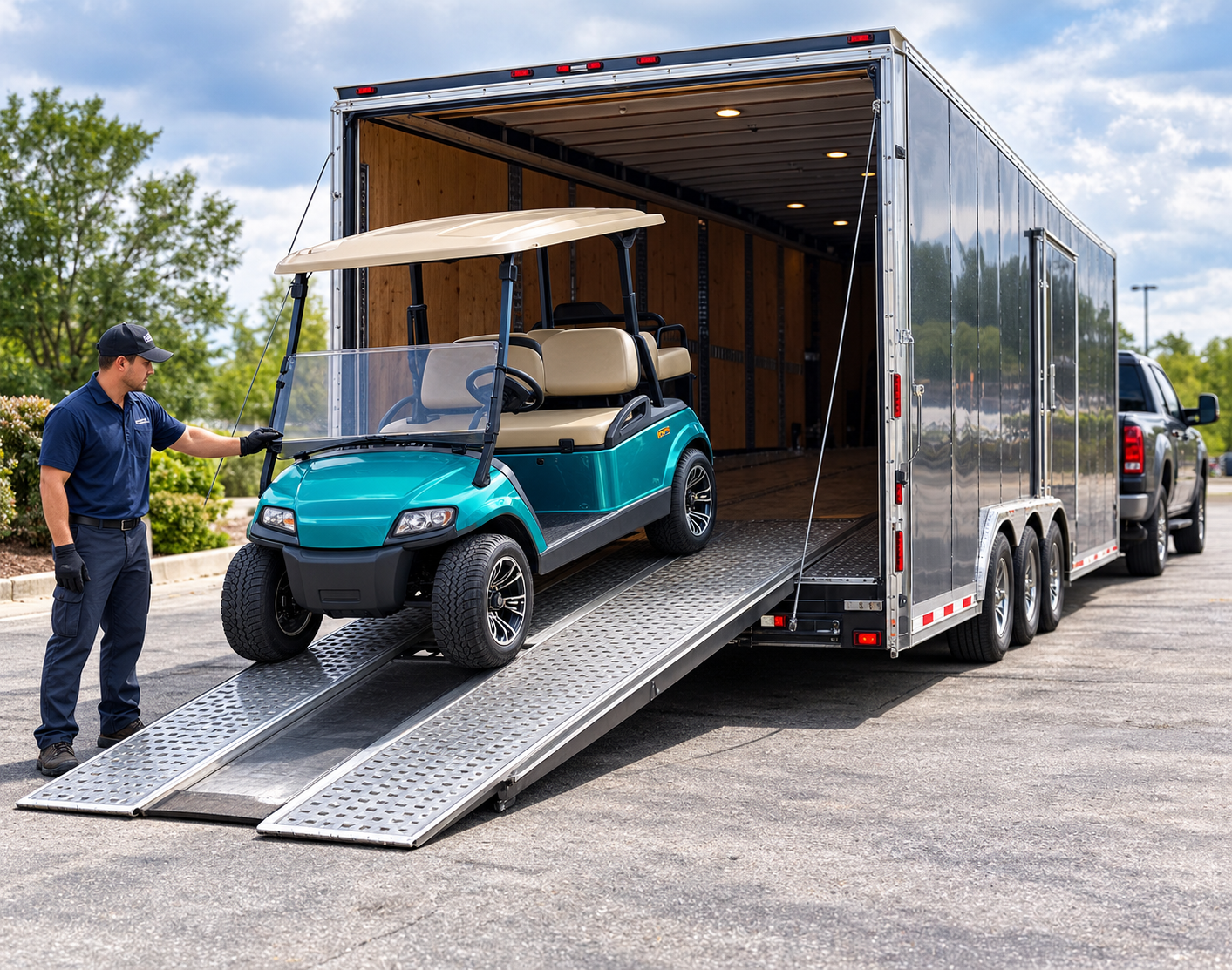
If you're trying to ship a golf cart, a UTV, an ATV, or a mini truck like a Subaru Sambar, Suzuki Carry, or Daihatsu Hijet, none of them move the way a sedan does — and standard car-hauler equipment is built entirely around a sedan's dimensions. I see this constantly in coastal and beach towns, where these vehicles are everyday transportation rather than a novelty, but the underlying problem is the same no matter where you're shipping from or to. Here's the one thing that actually explains why, and what to do about it.
Why Standard Equipment Doesn't Fit
A standard open car hauler — steel rails, wheel straps, sometimes called a 'stinger' setup — is built around three numbers: a sedan's wheelbase, its tire width, and its tire diameter. The rails are spaced for that wheelbase, and the wheel net or strap system is sized to grab a tire of roughly that width and height.
Golf carts, UTVs, ATVs, and mini trucks don't share those numbers with a sedan, and they don't share them with each other either — a narrow-track ATV, a wide sport UTV, and a compact mini truck can all be wrong for the same equipment in three completely different ways. Load one onto equipment sized for the wrong numbers, and you end up improvising: straps in the wrong place, a vehicle that isn't actually secured the way it looks like it is, or a load that takes twice as long because nothing about the vehicle matches the equipment that showed up.
The fix isn't complicated. It's knowing the vehicle's wheelbase, tire width, and tire diameter before the truck arrives, not measuring it in the driveway.
Golf Carts
In a lot of coastal and resort communities, a golf cart isn't recreational — it's how people actually get around. That means golf carts move for the same reasons cars do: relocations, seasonal moves, a dealer selling to an out-of-state buyer. Standard and lifted carts both have a narrower track and shorter wheelbase than any car, and a lifted cart adds height and tire diameter on top of that. Either way, it's a different set of numbers than the equipment on a typical car hauler is built for.
UTVs and Side-by-Sides
UTVs are the category where 'narrow' isn't automatically true, and that's exactly what trips people up. A trail-rated UTV is often built deliberately narrow — around 50 inches wide — specifically so it fits on ATV trails. A sport UTV can be 64 to 72 inches wide, closer to a small car. Two vehicles in the same category can need two completely different approaches, which means guessing based on 'it's a UTV' isn't good enough.
The model-specific wheelbase and width have to be confirmed before equipment gets chosen, not assumed from the vehicle type. That's exactly why a real UTV shipping quote should come after you've told us the exact model, not before.
ATVs and Four-Wheelers
ATVs are usually the most extreme version of this problem — the narrowest track width of anything in this category, often paired with a short wheelbase. They're common at beach and dune access points for exactly that reason: narrow enough to get where a full-size vehicle can't. That same narrowness is what makes them a poor fit for equipment built around a sedan's dimensions, and it's often the vehicle type where an inexperienced crew improvises the most.
Mini Trucks: Subaru Sambar, Suzuki Carry, and Daihatsu Hijet
Kei and mini trucks — the Subaru Sambar, Suzuki Carry, and Daihatsu Hijet are the three you'll see most often — look like a small pickup, and that's exactly what leads people astray. Japan's kei-vehicle class caps these trucks at roughly 58 inches wide, with a wheelbase built to match — narrower than a lot of golf carts, and nowhere close to a US sedan or pickup's numbers. A lot of these trucks are bought for farm work or private property use, which has nothing to do with how they get secured on a trailer.
Most of these trucks have already made one long trip by the time they reach a US buyer — imported by container from Japan — and the domestic move from there is where the same equipment problem shows up all over again: rails and straps sized for a full-size vehicle, on a truck that's a fraction of the width. Same story as the golf cart and the ATV, just a different-looking vehicle wrapped around it.
Sambar, Carry, or Hijet — the numbers are close enough between all three that the same planning applies regardless of which one you've got, which is why it's worth working with a mini truck shipping company that already knows these kei-class dimensions instead of one guessing from a photo.
Open or Enclosed: What Actually Matters
Both open and enclosed transport work for this entire category — this isn't a 'you must use enclosed' situation. The honest breakdown:
Enclosed trailers typically have a solid, flat floor rather than fixed rails, which makes them a safer default for any of these vehicles. Instead of being locked into rail spacing built for a sedan's wheelbase, the vehicle can be tied down at whatever points actually make sense for its frame and dimensions. That's usually reason enough on its own.
For golf carts specifically, there's a second reason: most stock golf carts are built to go 15 to 25 mph — that 25 mph ceiling is also the federal cutoff for what counts as a 'low-speed vehicle.' An open hauler travels the interstate at 65 to 75 mph. That cart was never engineered for that speed, that wind load, or that kind of sustained highway vibration, regardless of how well it's strapped down. That's a real, separate argument for enclosed transport that has nothing to do with how the vehicle is secured.
Open transport is still viable across this category, but it depends entirely on the carrier having the vehicle's real numbers before pickup day: wheelbase, tire width, and tire diameter, at minimum. Give a carrier those three measurements in advance, and the right straps and ramps show up with the truck. Skip that step, and you're relying on whoever's on-site that day to improvise.
Why This Keeps Being a Gap in the Industry
None of this is a secret, and none of it is particularly hard. It's just outside the day-to-day of moving sedans and SUVs, which is what most of the industry — brokers and their sales teams alike — spends the overwhelming majority of their time doing. An established, reputable company can still have a team that's simply never been trained on this specific category, because it doesn't come up often enough to build that muscle memory.
We're already working directly with golf cart dealers on this — a completed move under our belt, with another dealer relationship on deck — because our team brings years of hands-on experience in this industry to vehicles like these instead of treating them as an odd-shaped car. That experience is what lets us quote the right equipment before the truck ever shows up, instead of figuring it out in the driveway. Whether you book with us or another golf cart shipping company, it's worth confirming upfront that they've actually handled one of these vehicles before — the equipment and the timeline both depend on it.
What We Check Before We'll Quote One of These
This isn't a hypothetical checklist — it's what actually happens on our end before we put a number on a golf cart, a UTV, an ATV, or a mini truck:
- We get the wheelbase, tire width, and tire diameter before we quote equipment, not after a truck shows up and someone starts measuring in the driveway.
- If it's a UTV, we confirm the actual model instead of quoting off the category — trail and sport widths can differ by more than a foot, and that difference changes what shows up to move it.
- If it's a golf cart, we've already factored in that it wasn't built for highway speed before we ever get to how it's secured.
- We tell you specifically why we're recommending open or enclosed for your vehicle — it's not the same answer for every vehicle that comes through.
- For a Sambar, Carry, Hijet, or other mini truck, we confirm the actual width and wheelbase — Japanese kei-class dimensions aren't close to a US pickup's, and we're not guessing based on what it looks like in a photo.

That's not a list of questions to go interrogate a broker with. It's what we already run through internally, every time, before we'll put a quote in writing. If you ask another broker these same five things and the answers get vague, that tells you what you need to know too.
Frequently Asked Questions
Can you ship a golf cart long distance?
Yes. Standard and lifted golf carts both have a narrower track and shorter wheelbase than a car, so they should be quoted and equipped as their own category rather than treated like a small vehicle.
How much does it cost to ship a UTV, and does the model matter?
Cost depends heavily on the specific model, more than most people expect. A trail-width UTV (around 50 inches) and a sport UTV (64–72 inches) need different equipment entirely, so get a quote based on your exact model, not the general category.
Is enclosed transport necessary for a golf cart, UTV, or ATV?
Not strictly necessary, but it's usually the safer default for two reasons: enclosed trailers have a solid floor instead of fixed rails, which makes securing a narrow-wheelbase vehicle easier, and for golf carts specifically, most aren't built for highway speeds in the first place. Open transport works too, as long as the carrier has exact wheelbase and tire measurements before pickup.
How wide is a Subaru Sambar, Suzuki Carry, or Daihatsu Hijet compared to a regular pickup?
Japan's kei-vehicle class caps these trucks at roughly 58 inches wide, with a wheelbase to match — narrower than many golf carts, and far narrower than any US pickup. That's true across all three of the common imports, and it's why they need the same kind of equipment planning as a golf cart or ATV, not what you'd use for a full-size truck.
Tell us the wheelbase, tire size, and vehicle type up front and we'll quote the right equipment the first time.
Get a Quote to Ship Your Golf Cart, UTV, ATV, or Mini TruckThat is The Shipping Remedy.
Approved Transport Group LLC — USDOT# 9677802 | MC# 45556873 | Licensed Property Broker | Grasonville, Maryland